Likelihood for Censored Loss Data
Definition
Under right censoring at a known cap , an exact continuous loss is observed if it is below the cap; otherwise one observes only . With indicator for an exact observation, its likelihood contribution is under continuous losses and non-informative censoring (the censoring caps are independent of the losses and carry no information about ).
Interpretation
The policy exists in the sample even when its full loss is unknown. A capped observation gives a tail event, not a point density at the cap.
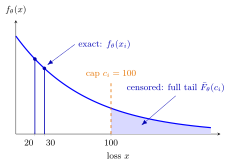
The curve is the exponential density at the Example's estimate . The exact losses 20 and 30 enter the likelihood through the heights and ; the observation capped at enters through the full tail probability , which at equals . The shading shows only losses from 100 to 205: its probability is , while the omitted tail above 205 has probability . The product has logarithm , the log-likelihood of the Example.
Move and the cap: the capped loss contributes , not a density height, so at the default cap rather than the obtained by treating the cap as an exact loss. The tail probability extends to infinity; only its visible part is shaded.
Maximum likelihood estimation maximizes the probability or density of the data actually recorded. A capped observation records a tail event, so its contribution is the survivor function at the cap rather than the density of an exact loss there.
Key Results
- Independent contributions multiply; exact observations contribute log densities and censored observations log survivor probabilities.
- For a common exponential rate, , if is the number of exact losses.
- If no exact losses occur, an interior maximum need not exist.
- An atom at the censoring boundary requires careful use of strict or weak tail events.
Examples
For exact losses 20 and 30 plus one observation capped at 100, exponential log-likelihood is . Thus .
Prerequisites
Related Concepts
Sources
- Risk Insurance · Lecture 5
Aliases: right censoring, policy-limit censoring, censored likelihood, censored data likelihood Keywords: censoring indicator, non-informative censoring, survivor function at the cap, capped losses, exponential MLE with censoring Symbols: delta, lambda, sum, theta
Last updated: 27 October 2026 11:52
Likelihood for Censored Loss DataMaximum Likelihood EstimationSurvivor FunctionPolicy LimitLikelihood for Truncated Loss DataLikelihood for Grouped Loss Data