Superposition of Compound Poisson Risks
Theorem
Let independent compound Poisson losses have rates and severity cumulative distribution functions (CDFs) , for . If , their sum is compound Poisson with rate and severity CDF .
Interpretation
Pooling portfolios (see Poisson merging) adds their claim-arrival rates. A randomly chosen pooled claim belongs to a portfolio with probability proportional to that portfolio's arrival rate.
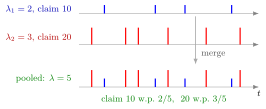
The figure uses the Example's portfolios with illustrative arrival times; each bar's height is the claim amount. Pooling keeps every claim, so the pooled stream has rate . A pooled claim comes from portfolio 1 and equals 10 with probability , and from portfolio 2 and equals 20 with probability (in the stretch drawn, 4 of the 10 claims are 10s), so the pooled severity is the mixture . The mean total loss is .
Change the two rates and claim sizes: the pooled compound Poisson law with rate and the mixed severity agrees with the convolution of the two portfolio totals at every point.
The pooled severity law is a mixture distribution: first choose the originating portfolio with probability , then draw a claim from that portfolio's severity law. Those probabilities are proportional to claim rates, not to portfolio counts.
Key Results
- Pooled severity weights are , not equal portfolio weights unless rates are equal.
- Independent losses have additive means and variances.
- Multiplying the component moment generating functions (MGFs) yields when the MGFs exist.
- The result also holds without a finite positive MGF, by viewing the pooled claims as one Poisson arrival stream in which each arrival independently carries a portfolio label (probability ) and a severity from ; compare Poisson splitting.
Examples
Two portfolios have rates 2 and 3 and fixed claim amounts 10 and 20. Their pooled rate is 5 and severities are 10 with probability and 20 with probability . Mean total loss is 80.
Prerequisites
Related Concepts
Sources
- Risk Insurance · Lecture 4
Aliases: sum of independent compound Poisson losses, pooled severity mixture, compound Poisson superposition, sum of compound Poisson risks Keywords: pooling portfolios, λ = λ_1 + ... + λ_m, severity weights λ_j/λ, Poisson merging, mixture of severity distributions Symbols: lambda, sum
Last updated: 16 October 2026 22:28
Superposition of Compound Poisson RisksCompound Poisson DistributionMixture DistributionPoisson MergingPoisson Splitting