Zero-Utility Premium
Definition
For strictly increasing concave utility , the zero-utility premium solves , when a finite solution exists. It is the insurer's indifference price at reference wealth zero. Utility must be defined on every relevant net outcome.
Interpretation
Premium income offsets the insured loss until expected utility equals the no-contract reference. The name refers to zero change in utility, not necessarily a utility function whose value is zero.
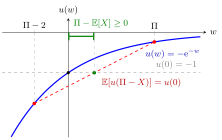
The figure takes (so ) and a loss equal to 0 or 2 with probability each, numbers chosen for illustration. The zero-utility premium is then , with net outcomes and . Their expected utility, the midpoint of the dashed chord, equals and sits above . Because the concave curve lies above its chords, it reaches the level already at , so : the premium carries a nonnegative loading.
Change , the loss and its probability : is the premium that leaves expected utility equal to , and it never falls below . Switch to linear utility and the loading vanishes.
Insurance indifference premiums gives the insurer's equation at general reference wealth; setting that wealth to zero gives this equation. Among premium principles and their properties, nonnegative loading follows from concavity: Jensen's inequality gives , hence under the stated conditions.
Key Results
- If is strictly increasing, any finite solution is unique.
- Concavity implies under the needed integrability conditions.
- Exponential utility gives the exponential premium principle.
- For bounded losses, a solution is between the smallest and largest possible loss under suitable continuity and domain conditions.
- For general utilities, reference wealth affects the indifference price.
Examples
With risk-neutral , the equation is , giving the net premium. With it gives the exponential premium.
Prerequisites
Related Concepts
Sources
- Risk Insurance · Lecture 12
Aliases: utility-equivalence insurer premium, principle of zero utility, zero-utility principle Keywords: E[u(Π - X)] = u(0), insurer indifference price, exponential utility gives the exponential premium, nonnegative loading by Jensen Symbols: alpha, pi
Last updated: 17 October 2026 21:53
Zero-Utility PremiumInsurance Indifference PremiumsPremium Principles and Their PropertiesExponential Premium PrincipleExpected Value Premium Principle