Convex Order and More Dangerous Risks
Definition
For integrable losses, convex order means for every convex function for which comparison is defined. For nonnegative losses this is equivalent to stop-loss order together with . The course calls the larger risk more dangerous in this equal-mean setting.
Interpretation
Convex order compares dispersion after removing a difference in mean. All risk-averse agents prefer the less dispersed loss when utility expectations are defined.
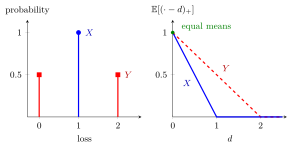
The figure uses the Example's risks. Both have mean 1, but spreads its mass to 0 and 2. On the right, and start from the common mean at , and the second is never smaller, so precedes in stop-loss order with equal means, which is the characterization of in the definition. The gap between the lines reflects the extra dispersion of , which also shows in the variances 0 and 1.
Spread and around their common mean 1: both stop-loss transforms start at , and the more dispersed risk lies above at every , so when has the larger spread.
Convexity and concavity determines which test functions enter the comparison. Convex functions penalize dispersion; their negatives are concave, explaining the preference of risk-averse wealth utilities for the less dispersed loss.
Key Results
- The order forces equal means because both and are convex.
- With finite second moments, ; if the distributions differ, this inequality is strict.
- Variance ordering alone does not imply convex order.
- Convex order is not preserved by every convex transformation, because equal means can be lost.
Examples
A constant loss of 1 is below the equal-probability loss on in convex order. Their variances are 0 and 1.
Prerequisites
Related Concepts
- Thicker-Tailed Comparison
- Second-Order Stochastic Dominance
- Expected Utility and Risk Aversion
- Standard Deviation Premium Principle
- Variance Premium Principle
Sources
- Risk Insurance · Lecture 10
Aliases: equal-mean stop-loss order, more dangerous order, convex order, more dangerous risk, convex ordering Keywords: X ≤_cx Y, convex test functions, equal means, variance comparison, constant versus two-point loss
Last updated: 17 October 2026 21:53
Convex Order and More Dangerous RisksSecond-Order Stochastic DominanceStop-Loss Separation TheoremStop-Loss OrderConvexity and ConcavityThicker-Tailed ComparisonExpected Utility and Risk AversionStandard Deviation Premium PrincipleVariance Premium Principle