Endowment Insurance
Definition
An -year endowment insurance pays a unit benefit at death within the term or at time on survival. With immediate death settlement, . With annual death settlement and integer , . The actuarial present values (APVs) are denoted and , respectively.
Interpretation
Every lifetime leads to a payment. The uncertainty concerns when that payment occurs, up to the fixed maturity time.
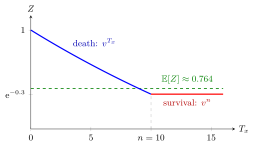
The figure plots the present value against for and , so . A death before time 10 gives , which falls from 1 to ; survival to time 10 gives the fixed maturity value . Every outcome lies between these two values, and with the mean is the Examples value .
Key Results
- APV equals the APV of an -year term insurance plus .
- Death and survival benefits occur on disjoint events; their product is zero. Their covariance is generally negative, not zero.
- To calculate the second moment, square each discounted payment on its own event. Do not add component variances without a covariance term.
Examples
At , and , immediate death-or-survival APV is .
Prerequisites
Related Concepts
Sources
- Life Insurance · Lecture 4
Aliases: n-year endowment assurance, death-or-survival benefit, endowment assurance, n-year endowment insurance, endowment policy Keywords: term insurance plus pure endowment, v^min(T x, n), A x:n angle, negative covariance of death and survival benefits Symbols: delta, lambda
Last updated: 14 October 2026 08:21
Endowment InsuranceLife Insurance Valuation RecursionsTemporary Life AnnuityTerm Life InsurancePure EndowmentVariance of an Insurance Present Value