Variance of an Insurance Present Value
Definition
For a discounted insurance benefit , its variance is , provided the second moment is finite. For a unit benefit paid once on event at time , and .
Interpretation
The second moment uses twice the force of interest because the discount factor is squared. Mortality and the covered event stay the same.
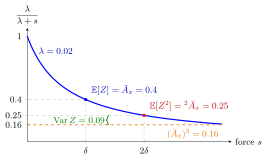
For the Examples case (constant force of mortality ), the actuarial present value (APV) of unit whole life insurance valued at force of interest is , the blue curve. The first moment is its value at , namely ; the second moment is its value at , namely , which lies above . The gap is the variance.
Actuarial present value gives the first moment of the discounted benefit. Its variance also needs the APV of the squared payment, evaluated with the squared discount factor; the first moment alone does not determine risk.
Key Results
- For a unit benefit, a second-moment symbol such as means valuation at force , not .
- If annual effective interest is , the double-force equivalent rate is , not .
- For benefit , the second moment is multiplied by .
- If benefits vary with time, both the benefit function and the discount factor must be squared.
Examples
For unit whole life insurance with and , the second moment is . Variance is .
Prerequisites
Related Concepts
- Endowment Insurance
- Whole Life Annuity Due
- Varying Life Annuity Payments
- Varying Life Insurance Benefits
- Interest and Discounting
Sources
- Life Insurance · Lecture 4
Aliases: second moment of insurance PV, double-force valuation, variance of present value, variance of a death benefit Keywords: 2A x minus A x squared, valuation at force 2 delta, (1+i)^2 - 1, Var(Z) = E[Z^2] - E[Z]^2, double force of interest Symbols: delta, lambda, tau
Last updated: 17 October 2026 21:53
Variance of an Insurance Present ValueActuarial Present ValueVariance and Standard DeviationEndowment InsuranceWhole Life Annuity DueVarying Life Annuity PaymentsVarying Life Insurance BenefitsInterest and Discounting