Actuarial Survival and Death Probabilities
Definition
For a life aged with future lifetime , define and for . The deferred death probability is
Here is the deferment and the subsequent coverage period. An omitted left-hand duration means one year: , .
Interpretation
These symbols encode the age, waiting period and coverage period of a survival event. Reading those three parts prevents confusion between dying within a period and surviving until it begins.
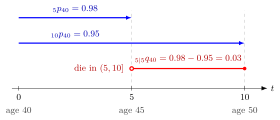
The figure uses the Examples values for a life aged 40. The blue arrows are the survival events and ; the red interval is the deferred death event , open at 5 and closed at 10. Surviving past time 5 means either surviving past time 10 or dying in , so , a probability measured from age 40.
The multiplication rule for conditional probability explains survival over successive periods: first survive to duration , then survive another years given attained age . This gives whenever the first survival probability is positive.
Key Results
- .
- .
- when survival to has positive probability.
Examples
If and , then . This is an unconditional probability at age 40, not the conditional five-year death probability at age 45.
Prerequisites
Related Concepts
Sources
- Life Insurance · Lecture 1
Aliases: international actuarial notation, deferred mortality probability, survival probability, death probability, deferred death probability, tpx, tqx, probability of death, probability of survival Keywords: probability of dying between two ages, u|t q x deferred mortality, t+u p x = t p x times u p x+t, p x plus q x equals one
Last updated: 22 October 2026 19:04
Actuarial Survival and Death ProbabilitiesCurtate Future LifetimeLife TablePure EndowmentFuture LifetimeConditional ProbabilityTerm Life Insurance