Makeham's Mortality Law
Definition
Makeham's law specifies the force of mortality at age as . In the standard increasing-age model, , and . These constants determine both an age-independent component and an exponentially increasing age component.
Interpretation
The constant term allows a background mortality rate, while the exponential term models increasing mortality at older ages. This is a model assumption, not a universal law of human mortality.
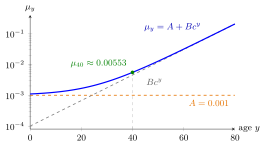
The figure plots the Examples parameters , and on a logarithmic vertical scale. At young ages stays close to the constant (dashed orange); at older ages it follows the Gompertz term , a straight line on this scale because is linear in . At age 40 the two parts give .
Key Results
-
For a life aged ,
Here is the natural logarithm, because ; a base-10 logarithm would give the wrong survival probability.
-
Setting gives the Gompertz form.
- Mortality depends on attained age , so the starting age must be retained in calculations.
Examples
With , and , the force at age 40 is . The survival formula integrates this changing force over the entire future interval.
Prerequisites
Related Concepts
Sources
- Life Insurance · Lecture 1
Aliases: Makeham law, Gompertz–Makeham mortality, Makeham's law, Gompertz–Makeham law Keywords: mu x = A + B c^x, Gompertz law (A = 0), exponentially increasing mortality, background mortality Symbols: integral, mu
Last updated: 17 October 2026 21:53
Makeham's Mortality LawForce of MortalityFuture LifetimeLife Table