Uniform Distribution of Deaths
Definition
The uniform distribution of deaths (UDD) assumption is for integer age and . If imposed in every subsequent year, the fractional part is uniform on and independent of .
Interpretation
Within each year of age, deaths are spread uniformly rather than concentrated at particular dates. The assumption gives a rule for interpolating an integer-age life table.
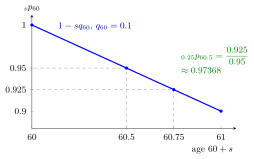
Under UDD the survival curve within a year of age is a straight line between the table values at integer ages: with , falls from to . The probability of surviving from 60.5 to 60.75 is the ratio of the two marked heights, , as in the example. The vertical axis starts at , so the drop is magnified. The line has constant slope, but relative to the shrinking survival level that slope grows, so increases within the year.
The curtate future lifetime identifies the year of death, and identifies the fraction lived within it. The uniform distribution assumption makes this fraction uniform on . As independent random variables, and permit separate averaging of fractional-year timing and the death year under UDD throughout the model.
Key Results
- .
- where the denominator is positive.
- For with , . The positive denominator means survival to the conditioning age has positive probability.
- UDD does not mean constant force within a year; its force of mortality increases when .
Examples
If , survival from age 60.5 to 60.75 is .
Prerequisites
Related Concepts
- Constant Force Within a Year of Age
- Death Benefits Payable at Fractional-Year Boundaries
- Complete and Curtate Expectation of Life
Sources
- Life Insurance · Lecture 2
Aliases: UDD, linear life-table interpolation, UDD assumption, uniform distribution of deaths assumption Keywords: fractional age assumption, s q x = s times q x, R x uniform and independent of K x, mu x+s = q x/(1 - s q x) Symbols: mu
Last updated: 27 October 2026 11:52
Uniform Distribution of DeathsDeath Benefits Payable at Fractional-Year BoundariesLife Annuities Payable Several Times a YearLife TableCurtate Future LifetimeUniform DistributionIndependent Random VariablesConstant Force Within a Year of AgeComplete and Curtate Expectation of Life