Future Loss Random Variable
Definition
For a policy still in force at duration , let , and be present values at time of future benefits, expenses and premium income. The gross future loss is . The net loss omits expenses. All quantities refer to the policy conditional on its being in force at .
Interpretation
The insurer faces random future obligations and random future premium income. Positive loss means future outgo exceeds income; negative loss means a future surplus.
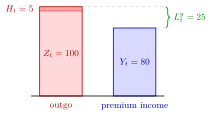
The figure takes the realized scenario from the Examples: benefits and expenses make up the outgo bar, premium income the income bar, and the gap between their tops is . A different realized lifetime would change all three bars, which is why is a random variable rather than a number.
Actuarial present value averages a random discounted cash flow. In contrast, , and retain the realized uncertainty; their conditional expectations, rather than the realized values themselves, enter an expected policy liability.
Key Results
- The time- discount origin differs from the issue-date discount origin.
- A policy ended by death before does not have an in-force future-loss distribution at .
- The course normally measures the loss after any benefit at but before the premium at . Annuity timing must be specified separately.
- An equivalence premium gives only under the same valuation and expense basis.
Examples
If the future benefit present value (PV) is 100, expense PV 5 and premium-income PV 80 in a realized scenario, the gross future loss is 25. These realized quantities need not equal their expectations.
Prerequisites
Related Concepts
Sources
- Life Insurance · Lecture 7
Aliases: gross future loss, net future loss, future loss, loss random variable, prospective loss random variable Keywords: benefits plus expenses minus premiums, gross loss L t g, loss at issue L 0, expected loss zero under the equivalence premium
Last updated: 16 October 2026 22:28
Future Loss Random VariableProspective Policy ValueActuarial Present ValueEquivalence Principle for Life Insurance Premiums