Force of Mortality
Definition
Under the course's absolutely continuous survival model, the force of mortality at attained age (the age reached years after age ) is
where and the derivative exists. Equivalently, it is the limit of as .
Interpretation
Mortality is measured per unit of time among those still alive. The force can exceed one; it is a rate and must be multiplied by a short duration to approximate a probability.
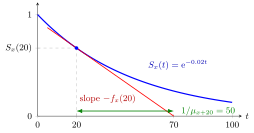
The figure uses the Examples force , so . At the tangent to has slope . Dividing the height by this rate of decline gives the time the tangent needs to reach zero, years, so a high force means a tangent that is steep relative to the height of the curve. Because this force is constant, the tangent at any reaches zero 50 years later.
Here is future lifetime, is its survivor function, and is its probability density function. Dividing the density by the probability of still being alive expresses a death rate among survivors rather than among all lives originally insured.
Key Results
- and .
- A constant force gives , an exponential future lifetime.
- An increasing force means that the death rate among survivors rises with time survived (positive duration dependence); a decreasing force means that it falls (negative duration dependence).
- For a finite force at , , with little- notation.
Examples
At constant force per year, the one-year death probability is , rather than exactly .
Prerequisites
Related Concepts
Sources
- Life Insurance · Lecture 1
Aliases: hazard rate, instantaneous mortality rate, hazard function, mortality intensity, intensity of mortality Keywords: mu x+t = f(t)/S(t), t p x = exp(-integral of mu), duration dependence, constant force gives an exponential lifetime, death rate among survivors Symbols: integral, lambda, mu
Last updated: 17 October 2026 21:53
Force of MortalityConstant Force Within a Year of AgeContinuous Life AnnuityMakeham's Mortality LawWhole Life InsuranceFuture LifetimeSurvivor FunctionProbability Density FunctionDerivative and Differentiability