Complete and Curtate Expectation of Life
Definition
The complete expectation of life at age is , whereas the curtate expectation is . Their -year term versions are and , respectively.
Interpretation
The complete quantity includes fractions of the final year. The curtate quantity counts only completed years. A term expectation stops accumulating lifetime after a fixed horizon.
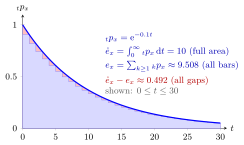
The figure uses the Examples force , so (drawn up to ). The full area to infinity is ; the visible part is . The bars have width one and take the height at the right end of each year, so the sum over all years is . Only the first 30 bars are shown, with total . The red gaps between the bars and the curve are the fractional final years that the curtate count drops; over all years they total about (about in the displayed interval), within the bound .
The curtate future lifetime counts complete future years. Summing its tail probabilities therefore gives the curtate expectation, whereas integrating the tails of includes the final fractional year.
Key Results
- and .
- and for integer .
- When expectations are finite, . Under uniform distribution of deaths (UDD) at integer age the difference is .
- when finite.
Examples
At force , the complete expectation is 10 years, while the curtate expectation is years.
Prerequisites
Related Concepts
Sources
- Life Insurance · Lecture 1
Aliases: life expectancy, term expectation of life, complete expectation of life, curtate expectation of life, expected future lifetime, mean future lifetime, expected remaining lifetime, mean residual life Keywords: e circle x, integral of t p x, sum of k p x, difference at most one year, one half under UDD Symbols: infinity, integral, lambda, sum
Last updated: 27 October 2026 11:52
Complete and Curtate Expectation of LifeCurtate Future LifetimeExpectationUniform Distribution of DeathsContinuous Life Annuity