Future Lifetime
Definition
For a life currently aged , the future lifetime is the remaining time until death, conditional on being alive at age . If denotes age at death and , then
The course assumes an absolutely continuous lifetime distribution. Thus is a continuous random variable, not a single number; its mean is the expected future lifetime.
Interpretation
The model updates the lifetime distribution when a person survives to a specified age. Two people at different ages generally have different remaining-lifetime distributions.
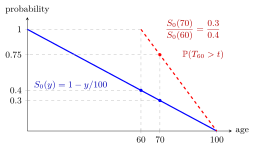
The figure uses the uniform example: the blue line is , and the dashed red line is drawn at attained age . Conditioning on survival to 60 rescales the remaining part of by , so the new curve starts again at 1 and still reaches 0 at age 100; at age 70 it equals .
Move and : rescales the rest of so that it starts again at 1. Under a constant force the rescaled curve is the newborn's curve once more.
The survivor function gives survival from birth. By conditional probability, survival another years given survival to age is , which is the remaining-lifetime survivor function.
Key Results
- Writing , conditioning gives whenever the conditioning probability is positive.
- The density is almost everywhere.
- A distribution of that does not depend on is a special property of a constant force of mortality (the memoryless property), not a general assumption.
Examples
If is uniform on , a survivor aged 60 has uniform on . Their probability of surviving another 10 years is .
Prerequisites
Related Concepts
- Actuarial Survival and Death Probabilities
- Force of Mortality
- Curtate Future Lifetime
- Makeham's Mortality Law
- Select and Ultimate Mortality
Sources
- Life Insurance · Lecture 1
Aliases: remaining lifetime, residual lifetime of a life, future lifetime random variable, time until death, residual lifetime, time to death Keywords: S0(x+t)/S0(x), conditioning on survival to age x, age at death T0, memoryless property at constant force
Last updated: 17 October 2026 21:53
Future LifetimeActuarial Present ValueActuarial Survival and Death ProbabilitiesCurtate Future LifetimeForce of MortalityAbsolutely Continuous DistributionConditional ProbabilitySurvivor FunctionContinuous Random VariableMakeham's Mortality LawSelect and Ultimate Mortality