Interest and Discounting¶
Definition¶
Under compound interest at annual effective interest rate , an amount invested at time grows to at time (in years). Equivalently, a payment of at time has present value at time , where
Here is the natural logarithm, so and . The present value of payments at times is .
Interpretation¶
The four quantities , , and describe one and the same interest basis; knowing any one of them fixes the others. They differ in what they measure:
- is interest paid at the end of the year on invested at the start;
- is the same interest paid at the start of the year: borrowing repayable in a year, one receives now;
- is the instantaneous growth rate, , and it is what turns discounting into an exponential function for payments at any real time .
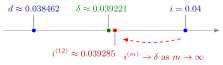
The figure places the rates of the first and third examples, all for the same basis , on one number line. They are different ways of quoting the same interest, so they are close but ordered: , as in the Key Results. The nominal rate equals for and approaches as ; at it is already within of .
Over one year grows to , while grows to : is the interest at the end of the year and the same interest at the start, and the dashed tangent at has slope . Raise : the nominal rate , the slope of the chord over the first of a year, falls from towards , and the nominal discount rate rises from towards it. Raise to see the gaps more clearly, or set the basis by to reproduce the second example.
Discounting moves money back in time. Insurance pages multiply each possible payment by first and then weight it by a survival or death probability; the result is an actuarial present value. When the payments are certain, as in an annuity certain, only the discounting step remains.
The force of interest plays the same role for money as the force of mortality plays for survival. If the force varies over time as , the discount factor to time is , just as .
Key Results¶
- and ; ; and .
- If interest is paid times a year at the nominal rate , the rate per period is , and equivalence with means , so . As , .
- Similarly, the nominal discount rate deducts at the start of each year, with , so . As , as well.
- For and : . For small rates all of them are close: .
- Level payments of at times have present value for , and at , by the geometric series formula; a continuous payment stream at rate has present value .
- Rates over other periods follow by compounding, not by proportion: the effective rate for years is , so a half-year rate is , not .
Examples¶
From to the rest. At :
A payment of in five years has present value . Weighted by a survival probability of , this gives the of the actuarial present value example.
From to the rest. Several Life Insurance examples use a constant force . Then , and ; as expected, .
A nominal monthly rate. At , the equivalent monthly rate is , so . It lies between and . The ratio is the UDD adjustment for monthly settlement on the page on death benefits payable at fractional-year boundaries. The matching nominal discount rate is , just below .
Ten payments in advance. At , payments of at times are worth , compared with undiscounted.
Prerequisites¶
Related Concepts¶
- Actuarial Present Value
- Annuity Certain
- Death Benefits Payable at Fractional-Year Boundaries
- Force of Mortality
- Variance of an Insurance Present Value
Sources¶
- Life Insurance · Lecture 3 (interest-theory review, textbook §4.3)
Aliases: discount factor, force of interest, effective interest rate, discount rate, present value, compound interest, effective rate of interest, rate of discount, continuously compounded interest rate Keywords: v = (1+i)^{-1}, d = 1 - v = iv, delta = log(1+i), v^t = e^{-delta t}, annual effective interest i, nominal interest rate i(m), time value of money Symbols: delta, infinity, integral, mu, sum
Last updated: 27 October 2026 11:52
Interest and DiscountingActuarial Present ValueAnnuity CertainExponential FunctionLogarithm and Logarithmic FunctionGeometric SeriesDeath Benefits Payable at Fractional-Year BoundariesForce of MortalityVariance of an Insurance Present Value