Constant Force Within a Year of Age
Definition
For integer age , constant-force interpolation, also called the constant force of mortality (CFM) assumption, takes for . If the annual survival probability is , the required force is . Different years may have different forces.
Interpretation
Survival declines exponentially within each annual interval. A piecewise constant force can match all integer-age entries without assuming one exponential lifetime distribution over every age.
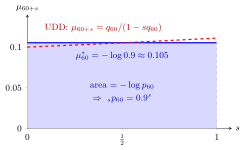
The figure takes from the Examples. Under CFM the force is flat at throughout the year; the shaded area up to is , so . The dashed curve is the uniform distribution of deaths (UDD) force , which rises from to about . Both forces have area over the whole year, so they agree at , but at CFM gives and UDD gives .
Change and : the flat force gives , while the dashed UDD force rises. Both have the same area over the year, so the two curves meet only at and .
A life table supplies . Integrating a constant force of mortality gives exponential survival within the year; matching its one-year value to determines .
Key Results
- and for .
- Within one interval, for .
- For an interval crossing an integer age, multiply survival probabilities for its successive pieces.
- CFM and UDD agree at integer ages but generally differ at fractional ages.
Examples
With , half-year survival is under CFM, compared with under UDD.
Prerequisites
Related Concepts
Sources
- Life Insurance · Lecture 2
Aliases: CFM interpolation, exponential life-table interpolation, CFM, constant force of mortality assumption, constant force assumption Keywords: fractional age assumption, s p x = p x to the power s, mu* = -log p x, piecewise constant force of mortality, exponential survival within the year Symbols: mu, square root
Last updated: 17 October 2026 21:53
Constant Force Within a Year of AgeLife Annuities Payable Several Times a YearLife TableForce of MortalityUniform Distribution of Deaths