Select and Ultimate Mortality
Definition
A select mortality model records both age at selection and elapsed duration since selection. Write for the one-year death probability of a life selected at age and observed years later. After a specified select period , the ultimate rate depends only on attained age: for .
Interpretation
Underwriting can make newly selected lives differ from other lives of the same age. The model keeps that duration effect until the assumed select period ends.
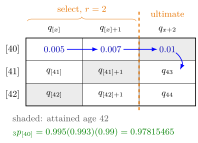
Each row of the table belongs to an age at selection and each column to a duration since selection; with select period the third column holds the ultimate rates, which depend on attained age only. A life selected at 40 moves along its row, and , then continues in the ultimate column with and later , so as in the example. The shaded cells all concern attained age 42 but hold different rates, , and , because those lives were selected at different ages.
A life table normally indexes annual mortality by attained age. A select table adds the age at selection and duration since selection; after the select period, valuation returns to the ordinary attained-age table.
Key Results
- for integer .
- Use select rates before duration and ultimate rates afterwards.
- Brackets identify selection age, not attained age. A life selected at 40 and now aged 42 is .
- The disappearance of selection after is a modelling convention, not evidence that all real selection effects vanish.
Examples
For a two-year select period with , and ultimate , three-year survival is .
Prerequisites
Related Concepts
Sources
- Life Insurance · Lecture 2
Aliases: select life table, ultimate life table, selection period, select mortality, ultimate mortality, select period, select table, select-and-ultimate table Keywords: q [x]+s notation, underwriting, selection age versus attained age, duration since selection Symbols: product
Last updated: 17 October 2026 21:53
Select and Ultimate MortalityLife TableFuture LifetimeWhole Life Insurance