Equivalence Principle for Life Insurance Premiums
Definition
The equivalence principle chooses a premium so that expected discounted premium income equals expected discounted benefits and, for gross valuation, expenses. Let be the benefit present value (PV), the expense PV and the PV of a unit premium stream. For a level premium , the gross equation is . Net valuation omits ; the resulting level premium is the net level premium, and "net" always means that expenses and loadings are excluded.
Interpretation
This balances expected cash flows at issue under a specified mortality and interest basis. It does not guarantee that every policy or every portfolio has zero realized loss.
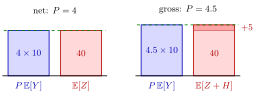
With the numbers from the Examples, the net premium makes equal , and the gross premium makes equal . The bars balance in expectation only; a realized policy can still produce a profit or a loss.
Move the trial premium : the orange gap is , which vanishes where income meets the outgo. Add a premium-related expense share and the outgo line tilts, so it must be solved together with .
Premiums paid annually in advance while the policyholder is alive form a whole life annuity-due. Its actuarial present value (APV) is the expected present value of one unit of premium each year, explaining the denominator in the whole-life premium formula.
Key Results
- If and expenses do not themselves depend on , .
- An annual net whole life premium payable in advance while alive is for unit annual-settlement death benefit.
- If premiums are payable for at most years, the denominator is .
- Premium-related expenses must remain in the equation and be solved together with .
Examples
If expected benefit PV is 40 and the unit premium-stream APV is 10, the net annual premium is 4. Expenses with APV 5, independent of the premium, raise the gross premium to 4.5.
Prerequisites
Related Concepts
Sources
- Life Insurance · Lecture 6
Aliases: net level premium, gross premium equivalence, equivalence principle, net premium, equivalence premium, gross premium, principle of equivalence, office premium, benefit premium Keywords: P = A x / ä x, expected premium income equals expected outgo, E[L 0] = 0, premium calculation, level annual premium
Last updated: 17 October 2026 21:53
Equivalence Principle for Life Insurance PremiumsFuture Loss Random VariableActuarial Present ValueWhole Life Annuity DueProspective Policy Value