Pure Endowment
Definition
A unit pure endowment pays at time only if the life aged survives to that time. Its present value is , and its actuarial present value (APV) is denoted .
Interpretation
The insurer pays for survival rather than death. The factor combines financial discounting with the probability that the later payment is due.
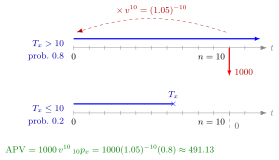
The figure uses the example below: , and a benefit of 1000 at . Only the upper scenario, , triggers a payment; the lower one ends with nothing paid. Discounting the payment by and weighting it by the survival probability gives the APV . Because only these two outcomes exist, is a scaled Bernoulli variable, so for benefit its variance is . Here , giving variance ; the unit-benefit formula below has .
Change , and : the APV is . For fixed positive , benefit and interest rate , varying gives variance , largest at . At , the life is alive at issue, so and the variance is zero; the slider is not linked to , so set it to to see this case.
The actuarial survival and death probabilities supply , the probability that the survival benefit is payable. Multiplying that probability by the discounted amount gives the APV, while the two possible payment values give its variance.
Key Results
- For benefit , APV is .
- for a unit benefit.
- when conditioning on survival is defined.
- A pure endowment is the survival component of an endowment insurance.
Examples
With and , a benefit of 1000 at time 10 has APV .
Prerequisites
Related Concepts
Sources
- Life Insurance · Lecture 3
Aliases: survival benefit, actuarial discount factor, pure endowment factor, n-year pure endowment Keywords: n E x = v^n n p x, payment only on survival, Bernoulli present value, variance v^2n n p x n q x
Last updated: 27 October 2026 11:52
Pure EndowmentDeferred Life AnnuityDeferred Life InsuranceEndowment InsuranceWhole Life Annuity DueActuarial Present ValueActuarial Survival and Death ProbabilitiesTerm Life Insurance