Term Life Insurance
Definition
An -year term insurance pays a death benefit only if death occurs within the coverage period . A unit benefit paid at death has present value . For integer and annual settlement, .
Interpretation
The contract provides protection during a fixed term and pays nothing on survival to its end. The death condition and settlement time must both be specified.
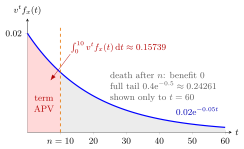
With constant force and , the death density is and , so the integrand is . The whole area under this curve is the whole life actuarial present value (APV) ; the 10-year term contract keeps only the red part left of the cutoff , which is , as in the example. The grey remainder, , belongs to deaths after the term. Moving the cutoff to the right adds area, which is why the APV increases with the term.
Move the term : the APV keeps only the red area of before , at the defaults, and it grows with the term.
Whole life insurance covers deaths at every future duration. Restricting its death-payment integral or annual payment sum to the first years gives the term contract; deaths after the cutoff contribute zero.
Key Results
- Immediate-payment APV is .
- Annual-settlement APV is .
- At constant force of mortality and force of interest , the immediate APV is .
- Increasing the term increases APV for a nonnegative fixed benefit.
Examples
With , and , the unit APV is .
Prerequisites
Related Concepts
- Pure Endowment
- Endowment Insurance
- Deferred Life Insurance
- Actuarial Survival and Death Probabilities
Sources
- Life Insurance · Lecture 3
Aliases: temporary life insurance, n-year term assurance, term insurance, term assurance, temporary assurance Keywords: death within n years, A 1 x:n angle, pays nothing on survival, n-year term cover Symbols: delta, integral, lambda, sum
Last updated: 17 October 2026 21:53
Term Life InsuranceEndowment InsuranceWhole Life InsurancePure EndowmentDeferred Life InsuranceActuarial Survival and Death Probabilities