Life Insurance Valuation Recursions
Proposition
For annual unit whole life insurance with actuarial present value (APV) , conditioning on the first year gives the valuation recursion
where is the annual discount factor and . The first term represents death during the year; the second represents survival followed by the remaining contract.
Interpretation
A long contract can be valued one year at a time. This also explains why product decompositions have both financial and survival discount factors.
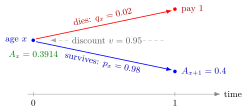
The figure follows the Examples. From age the life either dies within the year with probability , and the benefit 1 is paid at time 1, or survives with probability and then holds a contract worth at time 1. Weighting the two time-1 values by their probabilities and discounting by gives .
For endowment insurance, survival through the first year leaves an endowment contract with one fewer year. At zero remaining term the survival payment is due immediately, explaining the terminal value .
Key Results
- Let denote annual-settlement unit -year endowment APV. Then , with .
- Annual term insurance uses the same recursion but a terminal value of zero.
- Backward numerical valuation requires a terminal age or a justified tail treatment.
- The recursion concerns conditional values at successively older ages, not independent new policies.
Examples
If , and , then .
Prerequisites
Related Concepts
Sources
- Life Insurance · Lecture 4
Aliases: one-year insurance recursion, backward insurance valuation, insurance recursion, backward recursion for insurance values Keywords: A x = v q x + v p x A x+1, recursion for endowment insurance, terminal value, conditioning on the first year
Last updated: 14 October 2026 08:21
Life Insurance Valuation RecursionsWhole Life InsuranceEndowment InsuranceWhole Life Annuity Due