Complete and Curtate Expectation of Life
Definition
The complete expectation of life at age is , whereas the curtate expectation is . Their -year term versions are and , respectively.
Interpretation
The complete quantity includes fractions of the final year. The curtate quantity counts only completed years. A term expectation stops accumulating lifetime after a fixed horizon.
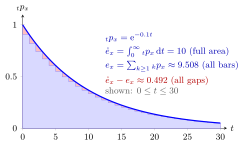
The figure uses the Examples force , so (drawn up to ). The full area to infinity is ; the visible part is . The bars have width one and take the height at the right end of each year, so the sum over all years is . Only the first 30 bars are shown, with total . The red gaps between the bars and the curve are the fractional final years that the curtate count drops; over all years they total about (about in the displayed interval), within the bound .
Change : is the area under , the total area of the unit bars, and the red gaps add up to less than 1. Switch on the term version to stop both at years. The displayed window is finite; compare its shown contribution with the full lifetime value and omitted tail in the readout.
The curtate future lifetime counts complete future years. Summing its tail probabilities therefore gives the curtate expectation, whereas integrating the tails of includes the final fractional year.
Key Results
- and .
- and for integer .
- When expectations are finite, . Under uniform distribution of deaths (UDD) at integer age the difference is .
- when finite.
Examples
At force , the complete expectation is 10 years, while the curtate expectation is years.
Prerequisites
Related Concepts
Sources
- Life Insurance · Lecture 1
Aliases: life expectancy, term expectation of life, complete expectation of life, curtate expectation of life, expected future lifetime, mean future lifetime, expected remaining lifetime, mean residual life Keywords: e circle x, integral of t p x, sum of k p x, difference at most one year, one half under UDD Symbols: infinity, integral, lambda, sum
Last updated: 27 October 2026 11:52
Complete and Curtate Expectation of LifeCurtate Future LifetimeExpectationUniform Distribution of DeathsContinuous Life Annuity